












HISTORY:
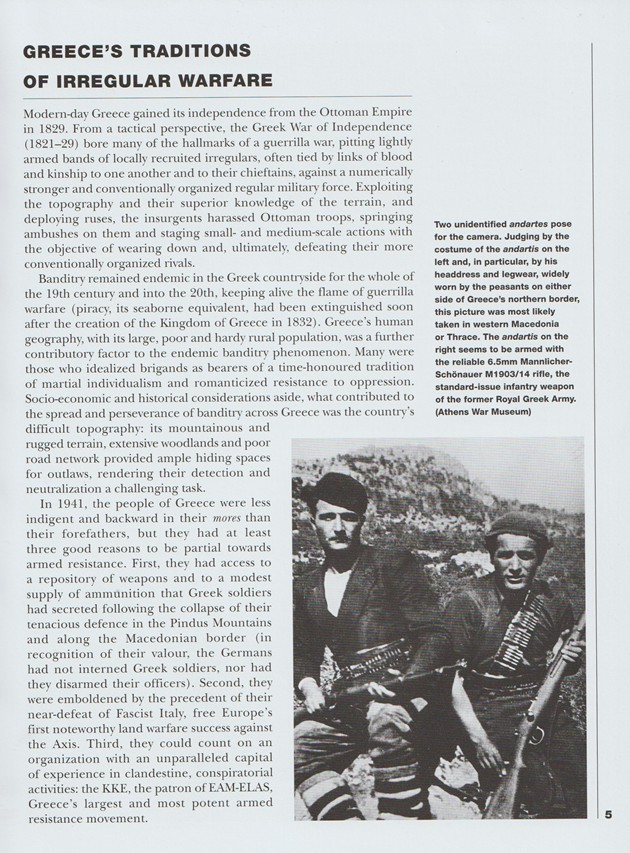
** Following the Axis invasion and defeat of Greece in April 1941, the country was occupied by German, Italian and Bulgarian troops. The Greek government withdrew to Egypt, but resistance organizations of differing political character soon sprang up, forming guerrilla forces that exploited Greece’s rugged terrain and limited communications. This study examines the Axis occupation forces in Greece during 1941-44 as well as the two main Greek Resistance organizations, ELAS and EDES (later EOEA). Phoebus Athanassiou charts the development of the fighting in Greece, a ferocious struggle in which the resistance and Axis forces each lost 15,000 men. **
** Quoted from the back cover of the book.
THE BOOK:
Osprey Publications has released Partisan Warfare in Greece 1941-44 as Number 562 in their Men-at-Arms series. It is a soft cover book with 48 pages and is the standard Osprey Publishing size of 7 1/4 x 9 3/4 inches. Included with the text are black and white photographs, color illustrations, detailed captions, detailed plate commentaries and more. It has a 2025 copyright, a publication date of May 22, 2025, and the ISBN is 978-1-4728-6752-0.
THE CONTENTS:
- Introduction
- Greece's Traditions of Irregular Warfare
- Resistance in Greece
- Chronology
- ELAS: The Pan-Hellenic Resistance Army:
- Command Structure
- Organization and Recruitment
- Weapons and Personal Equipment
- ELAS Naval Forces
- EDES: The Junior Resistance Army:
- Organization and Command Structure
- Recruitment Base
- Weapons and Personal Equipment
- Guerrilla Training, Tactics and Operations
- German Occupation Forces
- Organization and Occupation Record
- Anti-Partisan Tactics and Operations
- Italian Occupation Forces
- Bulgarian Occupation Forces
- Collaborationist Forces
- The Reckoning
- Further reading
- Plate Commentaries
- Index
THE TEXT:
Author Phoebus Athanassiou has written an excellent history about the partisan warfare that took place in Greece during World War Two during the years of 1941 through 1945. The text goes into great detail in all areas as outlined on the contents page, please refer to the list of contents that I have provided for the areas that are covered. The author does not take a one-sided stance on the subject and provides information equally and unbiased when detailing both the Allied and Axis forces and their actions. Phoebus Athanassiou provides information on the specific type of actions taken by the partisans such as the laying of mines and planting of explosives as well as targeting transportation objectives such as railways, tunnels and bridges as well as targeting communication objectives such as telephone lines. Another goal of their attacks was to tie up Axis security forces and engineering personnel as well as causing casualties among the Axis military troops. The author does not go into detail as to specific major operations taken by either side of the conflict but focuses on the actions taken by both sides as a whole. As I read through the text, I didn’t notice any spelling or grammatical errors. Grammar and spelling might not be an important factor to everyone however it is something that I take notice of and pass on my findings. As a reader that was not that knowledgeable about the partisan warfare in Greece, I found myself to be well informed on the subject upon finishing the book. This is a well-written history that will be of great use and interest to the knowledgeable partisan warfare enthusiast as well as the individual that is new to this World War Two subject and wants to learn about its history. Anyone wanting to add an excellent reference and history book on partisan warfare in Greece during World War II to their personal library will be pleased with this very informative book.
THE PHOTOGRAPHS:
A total of 34 black and white photographs are included in this volume. This title does not include any color photographs. The photographs range from wide angle photographs to close-up detailed photographs. They are a combination of in-action photographs, photographs removed from motion pictures to photographs that were staged for the photographer. Most of the photographs are clear and easily viewable; however, a few have an out-of-focus look to them, and some are quite dark, which makes it difficult to view some of the details, and others appear too light. This is typical for the discussed period of history, and the quality of the photographs is no fault of the author and does not take anything away from the book. Several of the images are stills, taken from period films, which would account for the lack of sharpness. One thing that I was appreciative of with the photographs is that a good majority of them are not overused photographs that tend to turn up in numerous publications The close-up photographs show items such as Greek, German, Bulgarian, British and Italian uniforms to include helmets, soft caps, footwear, pistol belts and ammunition pouches and ammunition belts, unit insignia, and military ribbons. Also shown are several small arms to include handguns, rifles, light machineguns, submachine guns and others as well as armor such as German tanks like the PzKpfw IV, German armored cars such as the Sd.Kfz 221, US-made 75mm pack howitzers and other subjects such as horses and various items of horse tack. Author Phoebus Athanassiou stuck to the title of the book and chose subject specific photographs and did not include photographs that strayed from the main subject. The majority, if not all, of the photographs will prove to be excellent reference material for the scale figure modeler due to the details they contain. The military historian, and the military uniform and smalls arms enthusiast will benefit from the excellent photographs as will anyone that is interested in partisan warfare in Greece during World War II.
THE ILLUSTRATIONS:
There are 8 plates featuring a total of 24 color illustrations included in the volume by illustrator Adam Hook.
There are brief captions that accompany the illustrations stating the individual’s names or military rank, military unit, locations and dates. The Plate Commentaries chapter, which starts on page 43, provides well written and detailed larger captions that provide specific information on the individuals shown such as their names or military rank, military unit, the uniform and accoutrements such as military rank and military unit patches, medals they are wearing, weapons, holsters, their individual histories, locations, dates, etc. The illustrations will prove to be valuable to the scale figure modeler as well as anyone interested in partisan warfare in Greece during World War II.
The illustrations are all very well done, nicely detailed and are of:
Plate A
Resistance Leaders
1. Protokapetanios Aris Velouchiotis ELAS GHQ, Lamia, October 1944
2. Antistratigos Stefanos Sarafis, Caserta, Naples, September 1944
3. Syntagmatarchis Napoleon Zervas, Derian, November 1942
Plate B
Resistance Forces (1)
1. Dioikitis tagmatos, ELAS, Amfissa, June 1944
2. Mavroskoufis, ELAS, Viniani, October 1943
3. Andartissa, 34th Parnassus Regiment, ELAS, Dervenochoria, October 1943
Plate C
Resistance Forces (2)
1. Dioikitis tagmatos, Athens Division, ELAS, October 1944
2. Aetopoulo, ELAS, Paramythia, April 1944
3. Andartis, 24th Regiment, EDES, Splantza, October 1943
Plate D
Resistance Forces (3)
1. SOE liaison officer, Roumeli, May 1943
2. Dioikitis tagmotos, 40th Regiment, EDES, Derviziani, April 1943
3. Andartis, 2nd Regiment, ELAS, Thebes, November 1944
Plate E
Axis Occupation Forces (1)
1. Küstenjäger, Küstenjäger-Abteilung ‘Brandenburg’, Rhodes, July 1943
2. Gefreiter, Jäger-Regiment 724, Agrinio, June 1943
3. SS-Sturmmann, SS-Polizei-Panzergrenadier-Regiment 7, Larissa, June 1944
Plate F
Axis Occupation Forces (2)
1. Caporale, 13° Reggimento di fanteria ‘Pinerolo’, kastoria, November 1942
2. SS-Unterscharführer, SS-Pionier-Bataillon 4, Kozani, July 1944
3. Carabiniere, VI Battaglione Carabinieri Reali, Messolonghi, March 1943
Plate G
Bulgarian Occupation Forces
1. Podpolkovnik, 7th Infantry Division, Thessaloniki, March 1943
2. Rednik, 16th Infantry Division, Xanthi, October 1942
3. Polkovnik, 11th Infantry Division, Komotini (Gjumjurdschina), June 1941
Plate H
Collaborationist Forces
1. Evzon, 2nd Security Regiment, Patras, May 1944
2. Ypostrátigos, 1st Security Regiment, Athens, September 1943
3. Militiaman, Lochos Asfaleias, EES, Kozani, March 1944
THE CAPTIONS:
The captions are well written and explain the accompanying photographs and illustrations in great detail eliminating any doubt as to what is shown. The captions go into very specific detail as to the specific individuals shown and their military rank and military unit they are assigned to, the types of uniforms and accoutrements such as cap badges, military ribbons and shoulder lanyards they are wearing, weapons, equipment carried and used, dates and locations and other such pertinent information. I was impressed by Phoebus Athanassiou’s captions as they are very helpful to the reader due to their detailed content as opposed to other captions that I have seen that are lacking in detail.
CONCLUSION:
As with the other Osprey Publishing titles I was impressed with this book. This is a very nice reference book that contains a well written informative text, many subject specific photographs and illustrations, well detailed captions and more, all detailing partisan warfare in Greece during World War II. As with the other Osprey Publishing titles, I have no hesitation recommending this book to others as it will be a welcome addition to one’s personal reference library.
Osprey Publishing also offers Partisan Warfare in Greece 1941-44 as:
Ebook (Epub & Mobi) ISBN: 978-1-4728-6753-7
and
Ebook (PDF) ISBN: 978-1-4728-6750-6
Osprey Publishing’s, Partisan Warfare in Greece 1941-44 is also available as a Kindle version through Amazon.
PRICE:
UK £12.99 / US $20.00 / CAN $27.00
This book was provided to me by Osprey Publishing. Please be sure to mention that you saw the book reviewed here on the KitMaker Network when making your purchase. Thank you.