












HISTORY:
** During the Civil War, as well as confronting the Confederates on land, the Union forces mounted several ambitious amphibious operations, both on the coast and along the banks of the great rivers. In this book, renowned historian Ron Field explains how the growing effectiveness of the Union Navy, the willingness of the Union Army to countenance combined operations, and the efforts of officers such as Ambrose Burnside, David Farragut, and John Dahlgren, ensured that amphibious warfare played a key part in the defeat of the South.
Various landing operations of the Navy and Army were supplemented by specialist units such as the 1st New York Marine Artillery, the Naval Battalion of the 13th New York Heavy Artillery, and the Mississippi Marine Brigade. These paved the way for the creation of the Fleet Brigade, composed of Union Navy sailors and Marines. The potential of amphibious warfare was revealed by the Union efforts to capture Fort Fisher in North Carolina. While the initial attempt failed in December 1864, a renewed effort in January 1865 resulted in a Union victory. Fully illustrated, this study investigates the amphibious tactics and technologies adopted by the Union forces during the Civil War, and the units raised and equipped to conduct combined operations. **
** Quoted from the back cover of the book.
THE BOOK:
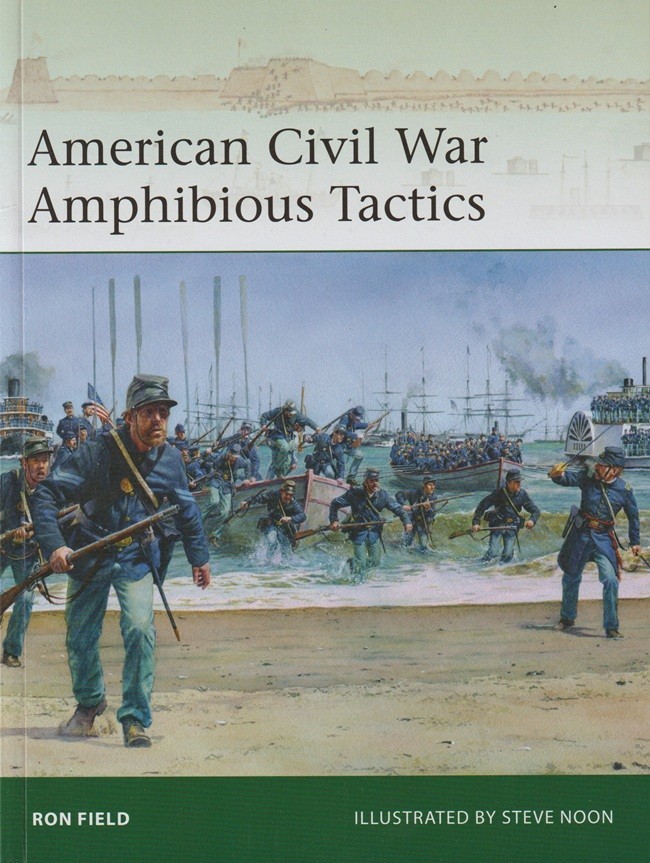
Osprey Publications has released American Civil War Amphibious Tactics as Number 262 in their Elite series. It is a soft cover book with 64 pages and is the standard Osprey Publishing size of 7 1/4 x 9 3/4 inches. Included with the text are black and white photographs and color photographs, color illustrations, detailed captions and more. It has a 2025 copyright, a publication date of June 19, 2025, and the ISBN is 978-1-4728-6316-4.
THE CONTENTS:
Introduction
Hatteras Inlet, August 28–29, 1861
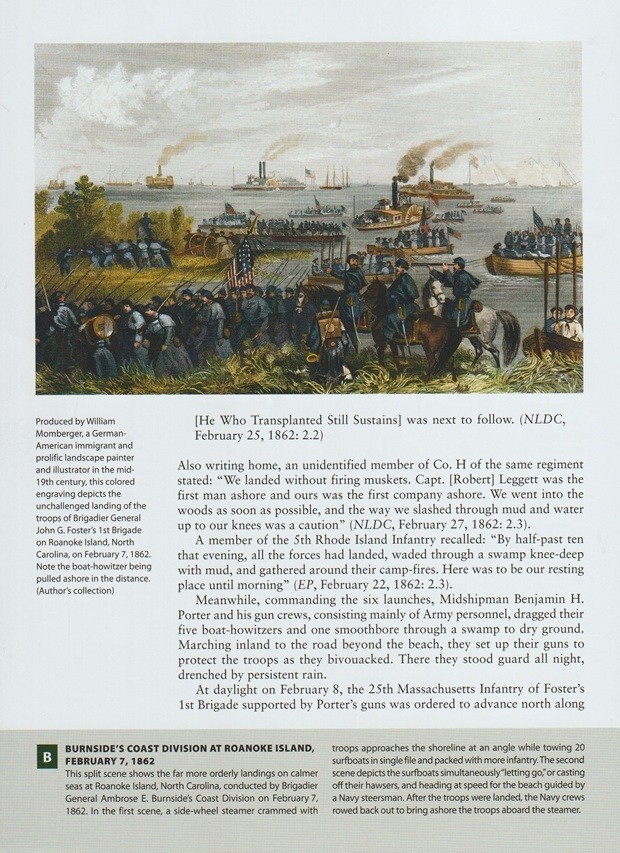
Roanoke Island, February 7–8, 1862
New Bern, March 11–14, 1862
The 1st New York Marine Artillery, 1862–63
The Naval Battalion, 13th New York Heavy Artillery, 1863–64
The Mississippi Marine Brigade, 1862–64
The Fleet Brigade,1863–64
Fort Fisher, December 23, 1864–January 15, 1865
Conclusion
Select Bibliography
Index
THE TEXT:
Author Ron Field has written an excellent history detailing a part of the American Civil War that is less known and discussed as are other subjects of the famous conflict such as the main battles that were fought and the end result of each. The author has provided the information in an easy-to-read format which the detailed oriented reader will benefit from, and Ron Field didn’t use what I refer to as fluff writing where a large amount of non-essential extra text is used just to help fill the pages. The text goes into very specific detail in all areas of the book as outlined on the contents page, please refer to the contents listing that I have provided for the areas that are covered through the book. The author provides details specific to eight individual conflicts and discusses all aspects of them starting with the initial ideas and planning put into them, the military units that would be involved and what their specific actions and targets would be, how the military personnel would reach the targets from the ships, which ships would provide covering fire and the types of ships that would be used as well as the names of the specific ships. The individual conflicts are detailed from the start of the actions, what took place with the military members while enroute to the intended targets, the fighting that took place and what the end results of the attacks were and if the overall actions were successful or unsuccessful. As well as detailing the fighting that took place, the author also provides details on things such as the type of terrain where the fighting took place and what the weather conditions were like, and he also details the obstacles and obstructions that the Confederate forces emplaced to help impede the Union forces. In addition to the history of the military units and their targets and actions there is also much information provided on the various ships and gunboats involved such as their types and their names like the USS Cumberland, USS Pawnee, USS Monticello and the USS Harriet Lane and the actions taken by the ships and their crews are well discussed. Along with his own words Ron Field has also provided numerous first-hand account quotes from individuals such as the Marine first loader on the starboard after gun on the USS Cumberland, a corporal in the 9th New York Infantry, the commander of the Navy side-wheel gunboat Hunchback, a captain in Company A., 10th Connecticut Infantry, a reporter for the New York Daily Tribune, and many others. The text in the book is nicely written and well detailed. As I read through the text, I didn’t notice any spelling or grammatical errors. Grammar and spelling might not be an important factor to everyone however it is something that I take notice of and pass on my findings. As a reader that did not know very much about amphibious tactics used during the American Civil War, I found myself to be well informed on the subject upon finishing the book. Anyone wanting to add an excellent reference and history book on amphibious tactics during the American Civil War, to their personal library will be pleased with this very informative and interesting book.
THE PHOTOGRAPHS:
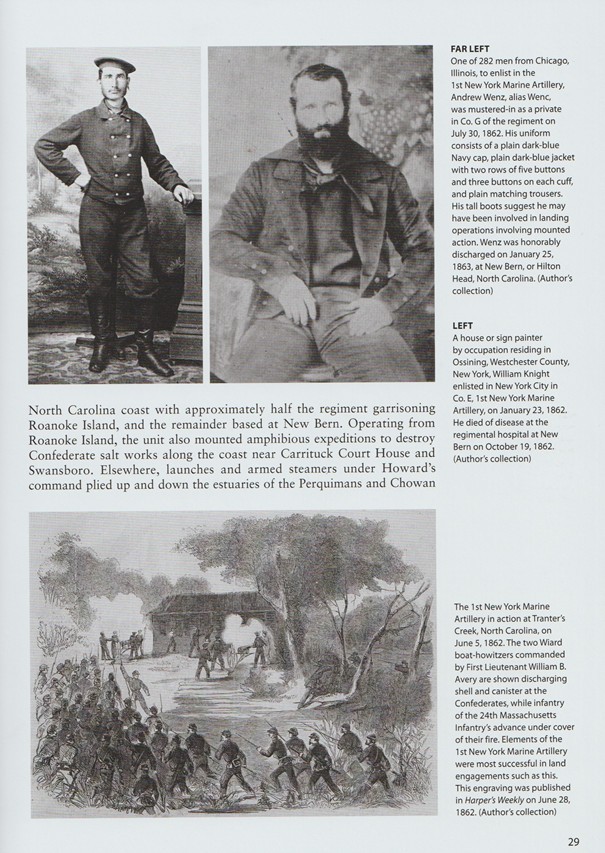
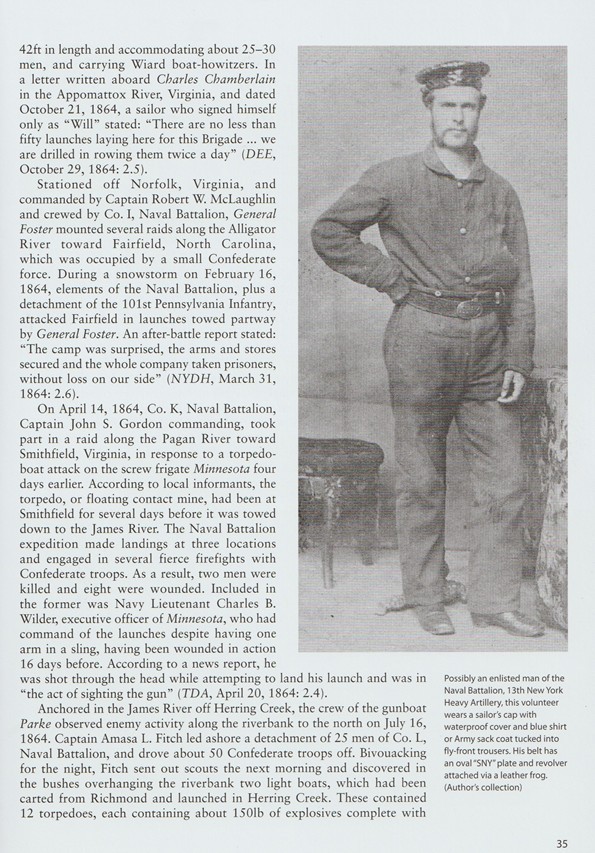
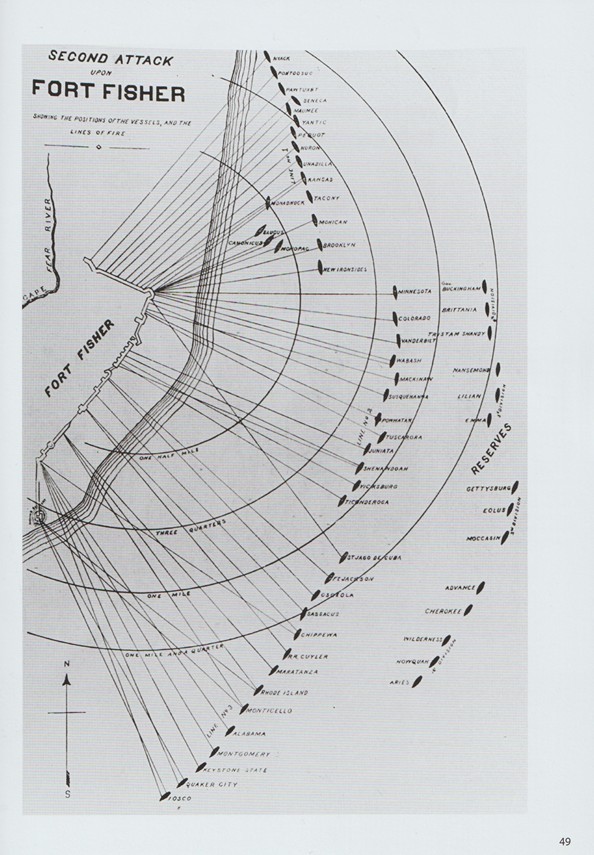
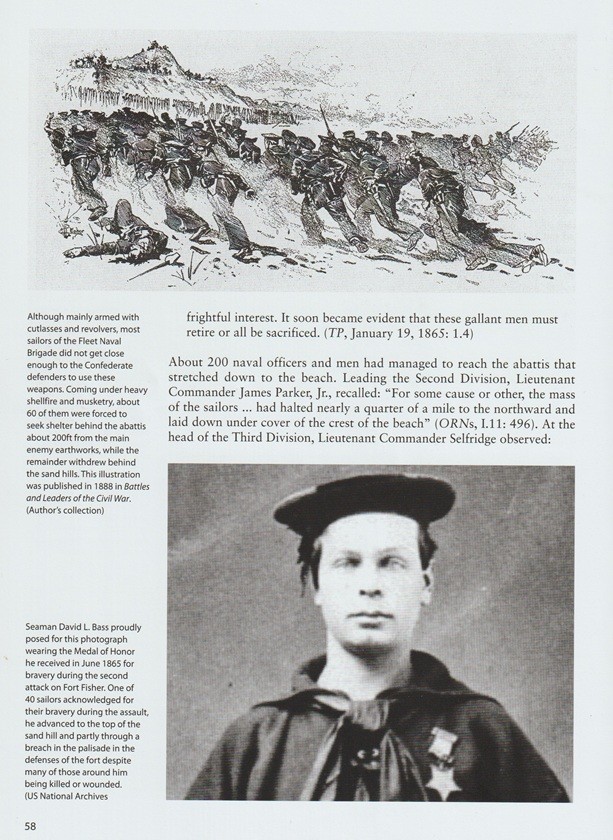
A total of 49 black and white photographs and 9 color photographs are included in this volume. All of the photographs are period photographs, or photographs of period drawings, sketches and professional artwork from the period. The photographs range from wide angle photographs to close-up detailed photographs. Due to the photographic technology of the time, they are mostly photographs that have been staged for the photographer. Several of the photographs are military profile studio portraits of uniformed individuals. The majority of the photographs are clear and easily viewable; however, a few have an out-of-focus appearance, and some appear to be too dark, and others appear too light. This is typical for the discussed period of history, and the quality of the photographs is no fault of the author and does not take anything away from the book. Author Ron Field stuck to the title of the book and chose subject specific photographs and did not include photographs that strayed from the main subject with the exception of one photograph near the last page of the book. There is a photograph and caption on page 62 of stretcher-bearers carrying a stretcher with a person on it in Veracruz, Mexico in 1914. I’m not sure why the picture and the caption are included, as the photograph is from the 20th century instead of the 19th century and during an entirely different conflict and in a different country and the text does not refer to it. The majority, if not all, of the photographs will prove to be excellent reference material for the scale figure modeler due to the details they contain. The military historian, and the military uniform and American Civil War enthusiast will benefit from the excellent photographs as will anyone that is interested in amphibious operations undertaken during the American Civil war.
THE ILLUSTRATIONS:
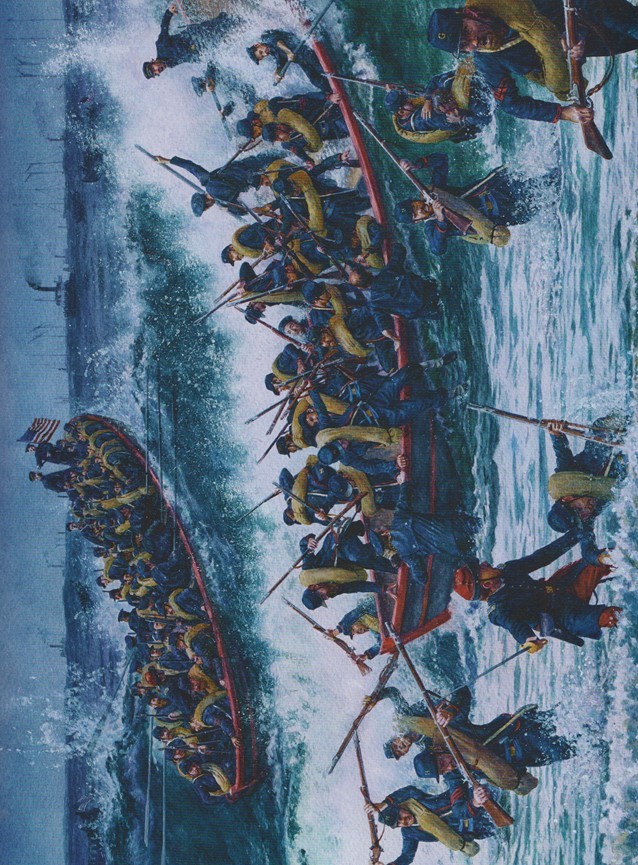
There are 8 color illustrations included in the volume by illustrator Steve Noon. Each color illustration is accompanied by a very detailed, well-written caption. The illustrations are all very well done, nicely detailed and are of:
Plate A
Hawkins’ Zouaves at Hatteras Inlet, August 28, 1861 (See attached scan)
Plate B
Burnside’s Coast Division at Roanoke Island, February 7, 1862 (A portion of this illustration is shown on the front cover of the book).
Plate C
The 1st New York Marine Artillery at Swift Creek Village, June 26, 1862
Plate D
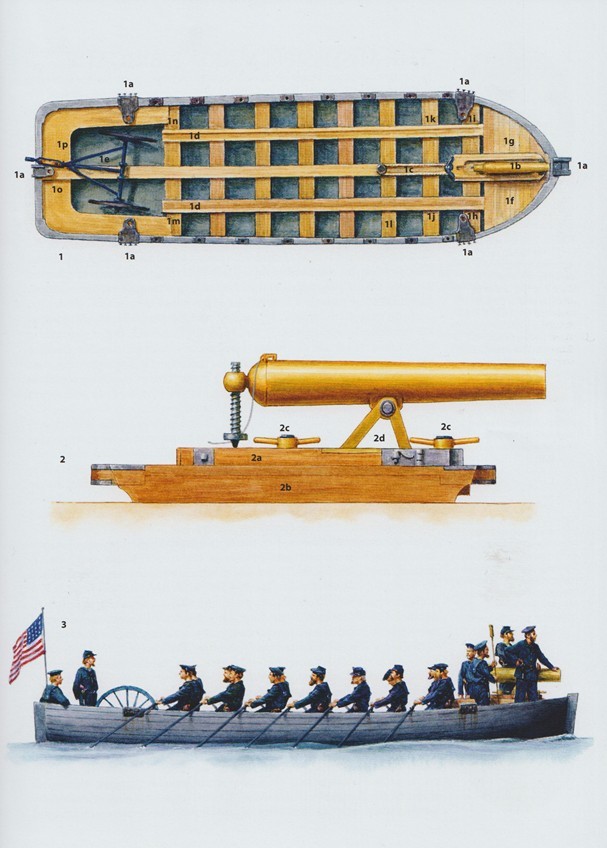
Launches and Howitzers (See attached scan)
1. Ground plan of an armed ship’s launch.
2. Boat-howitzer on sliding carriage.
3. Armed ship’s launch in action.
Plate E
“Horse Marines” at the Duck River Shoals, April 26, 1863
Plate F
The Fleet Brigade at Fort Sumter, September 8, 1863
Plate G
Union Army Transport Steamer, 1864
- Contains four illustrations of the steamer including cut-a-way views and has 16 points of interest such as gun placement and boiler locations discussed in the illustration’s caption on the previous page.
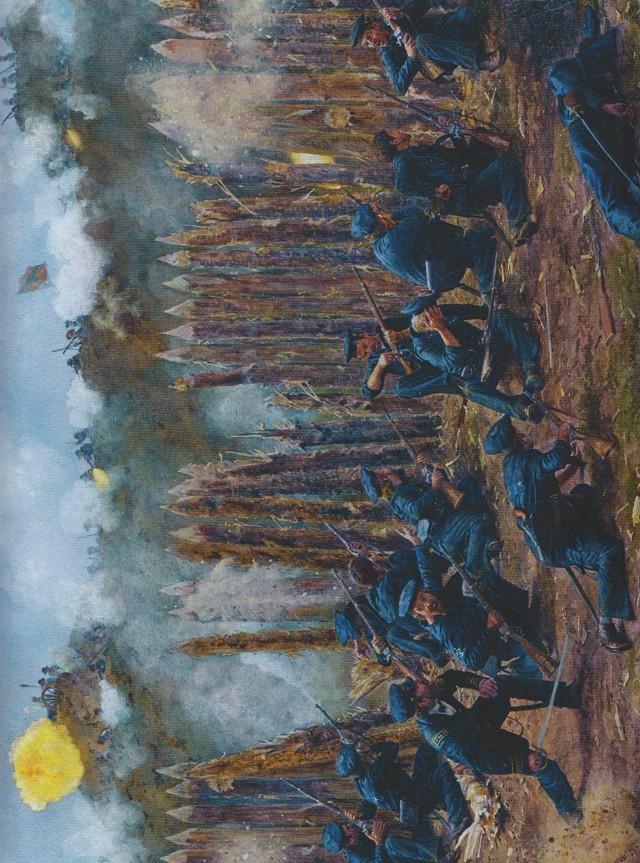
Plate H
Bravery at the Palisade, Fort Fisher, January 15, 1865
THE CAPTIONS:
The captions are well written and explain the accompanying photographs and illustrations in great detail eliminating any doubt as to what is shown. The captions go into very specific detail as to the specific individuals shown and their military rank and the branch of military and the military unit they are assigned to, the types of uniforms and accoutrements such as medals they are wearing, weapon types, the names and types of ships shown, the names of the artists of the various period illustrations and paintings shown, the names of the publications that the illustrations were posted in, dates and locations and other such pertinent information. I was impressed with Ron Field’s captions as they are very helpful to the reader due to their detailed content as opposed to other captions that I have seen that are very brief and lacking in detail.
CONCLUSION:
As with the other Osprey Publishing titles I was impressed with this book. This is a very nice reference book that contains a well written informative text, many subject specific photographs and illustrations, well detailed captions and more, all detailing amphibious operations undertaken during the American Civil war. As with the other Osprey Publishing titles, I have no hesitation recommending this book to others as it will be a welcome addition to one’s personal reference library.
Osprey Publishing also offers American Civil War Amphibious Tactics as:
Ebook (Epub & Mobi) ISBN: 978-1-4728-6317-1
and
Ebook (PDF) ISBN: 978-1-4728-6314-0
Osprey Publishing’s, American Civil War Amphibious Tactics is also available as a Kindle version through Amazon.
PRICE:
US $21.00 / UK £14.99 / CAN $28.00
This book was provided to me by Osprey Publishing. Please be sure to mention that you saw the book reviewed here on the KitMaker Network when making your purchase. Thank you.