











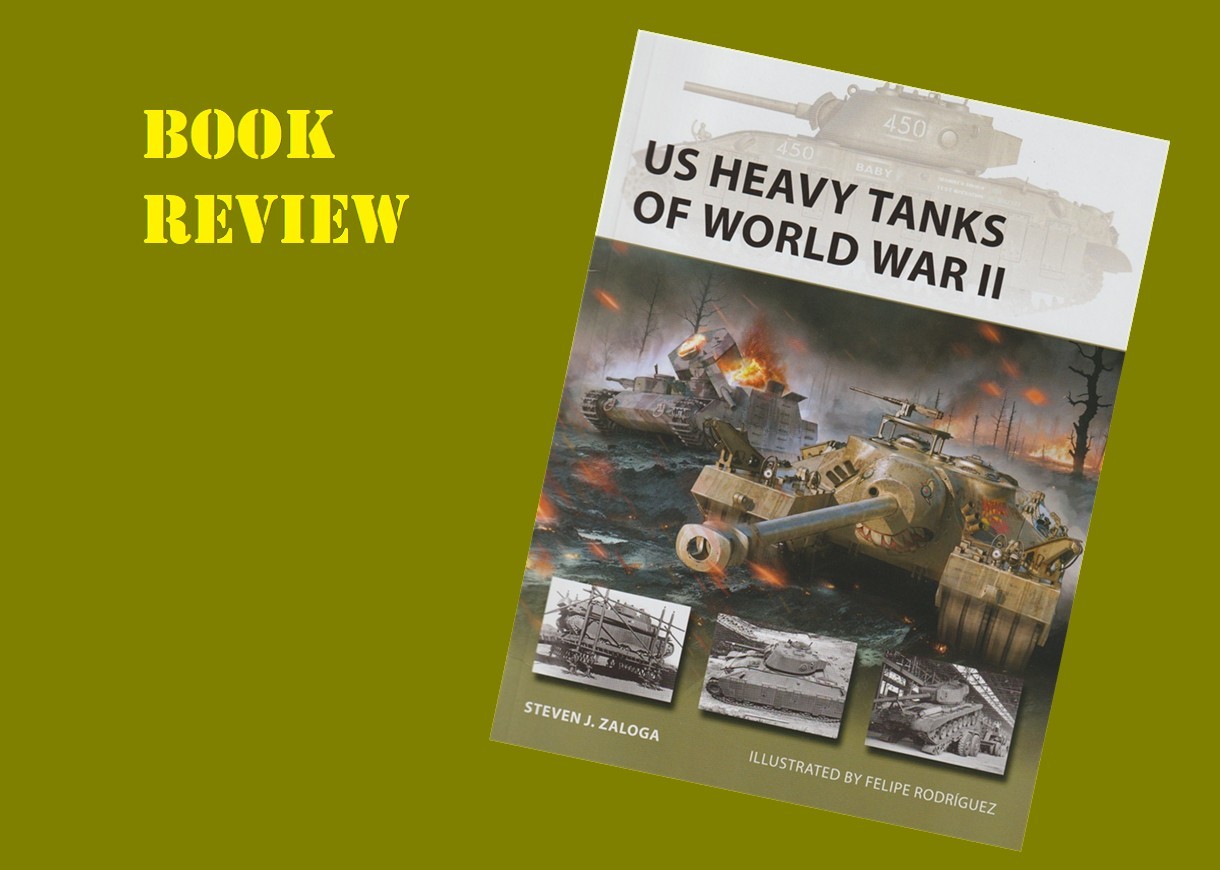
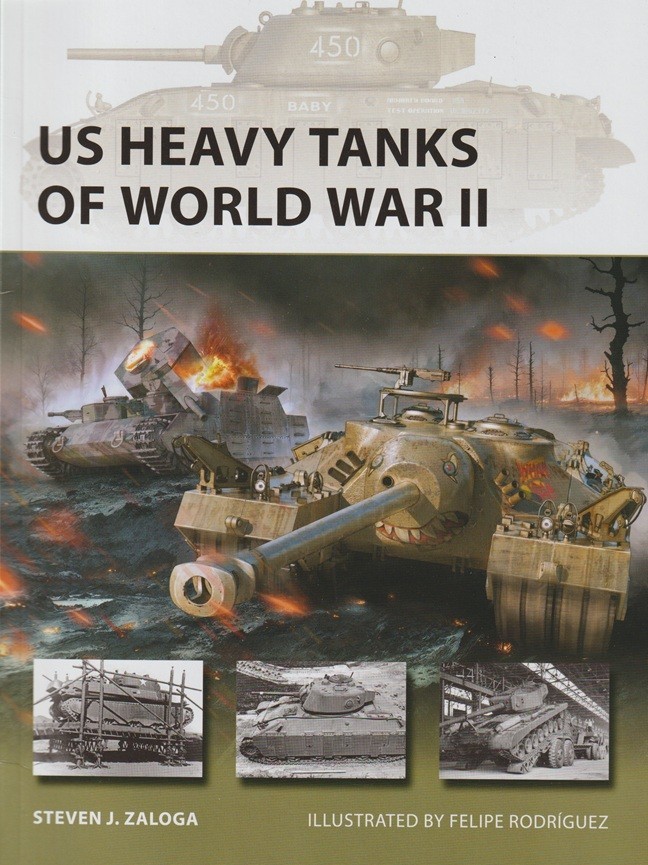
HISTORY:
** Throughout World War II the US Army worked on projects for new heavy tanks to rival Germany’s increasingly heavy panzers. In this book world-renowned armor expert Steven J. Zaloga traces and analyzes the US Army’s efforts.
The first design was the M6, which despite being type-classified, never saw combat use. The heavy T14 assault tank, earmarked for the British under Lend-Lease, was also developed, while the M4A3E2 assault tank went into production as a stopgap for the 1944 campaign in France. Also examined is the most outrageous US tank project of the war, the T28/T95 superheavy tank, as well as the heavy tank projects spawned by the M26 Pershing program, such as the T29, T30 and T34. Although production of these was envisioned in 1945-46, the end of the war put an end to any possibility of serial manufacture.
Illustrated with rarely seen archive photos and meticulously drawn new profiles of the key designs, this study assesses the US Army's plans to develop Tiger-competitors and the reasons why such monstrous machines were ultimately never required. **
** Quoted from the back cover of the book.
THE BOOK:
Osprey Publications has released US Heavy Tanks of World War II as Number 348 in the New Vanguard series. It is a soft cover book with 48 pages and is the standard Osprey Publishing size of 7 1/4 x 9 3/4 inches. Included with the text are black and white photographs, color photographs, full color illustrations, informational charts, cross section scale drawings, detailed captions and more. It has a 2026 copyright, a publication date of May 21, 2026, and the ISBN is 978-1-4728-7084-1.
THE CONTENTS:
- Introduction
- M6 (T1) Heavy Tanks
- T14 Assault Tank
- M4A3E2 Assault Tank
- T28 Super-Heavy Tank
- T29, T30, and T34 Heavy Tanks
- The T32 Assault Tank
- US Heavy Tanks in Retrospect
- Further Reading
- Index
THE TEXT:
Author Steven J. Zaloga has written an excellent history about the United States heavy tank design and development program as a response to Germany designing and manufacturing larger and heavier tanks during World War II. The text goes into very specific detail in all areas of the book as outlined on the contents page, please refer to the contents listing that I have provided for the subjects that are covered. The testing and evaluation of the tanks is discussed and findings such as issues with the brakes, air cleaners being inaccessible for servicing, inadequate ventilation in the turret when the main gun was being fired, problems with engine fittings, fuel system issues, suspension vulnerability, tracks being frequently thrown, transportation difficulties, and other such findings. Other information such as the cost of the test tanks as well as the number of test tanks ordered for evaluation is detailed. Technical specifications such as the tank’s height, width and length measurements, the tank’s weight, the numbers, types and calibers of weapons installed, armor thickness, engine type and size, steering systems and transmission types, and other such mechanical specifics are discussed. The decisions of the Ordinance Committee and their rulings on whether to proceed with the specific individual tanks or halt further development and the reason for their decisions is discussed in detail. In addition to his own words, the author has provided quotes from individuals such as Major General Jacob Devers, General Gladeon Barnes and other individuals involved with the various development projects as well as excerpts from official documents such as British assessment reports, military ordnance reports, military ordnance letters, Armored Board reports and other such documents. The text in the book is nicely written and well detailed. As I read through the text, I didn’t notice any spelling or grammatical errors. Grammar and spelling might not be an important factor to everyone however it is something that I take notice of and pass on my findings. As a reader that knew little about the United States heavy tank program during World War II, I found myself to be well informed on the subject upon finishing the book. Anyone wanting to add an excellent reference and history book on the United States heavy tank design and development during World War II to their personal library will be pleased with this very informative and interesting book.
THE PHOTOGRAPHS:
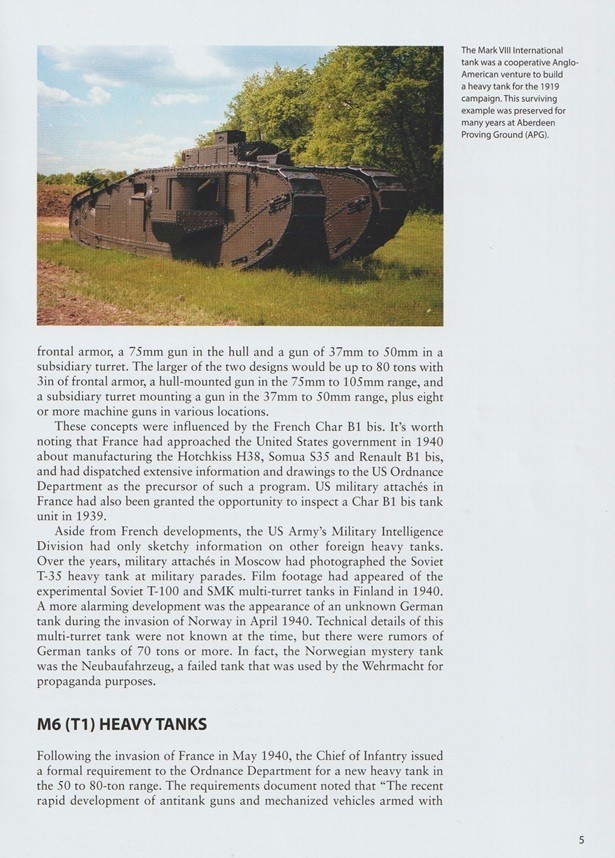
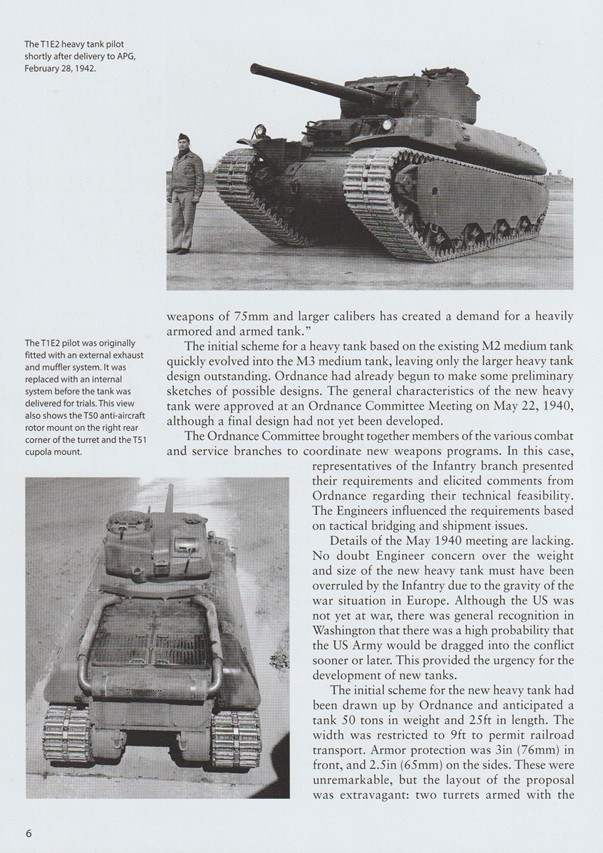
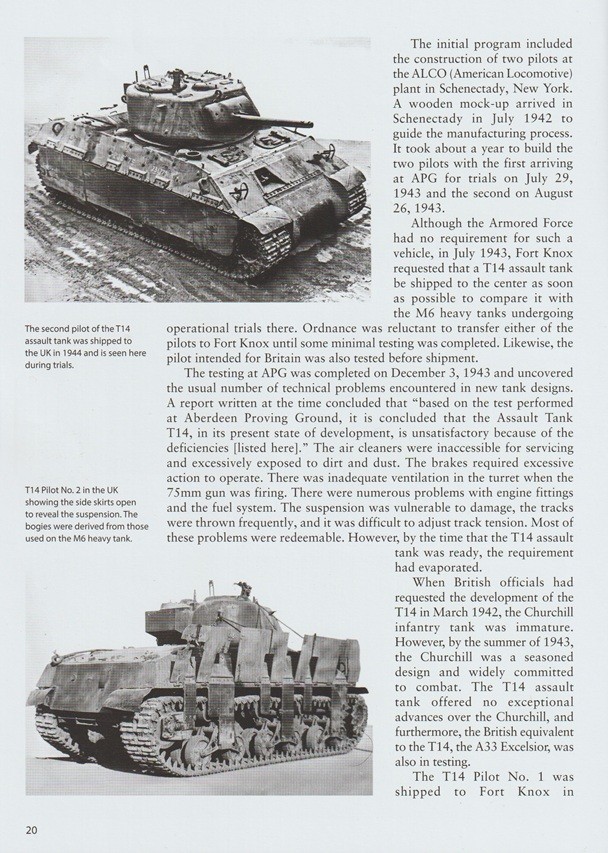
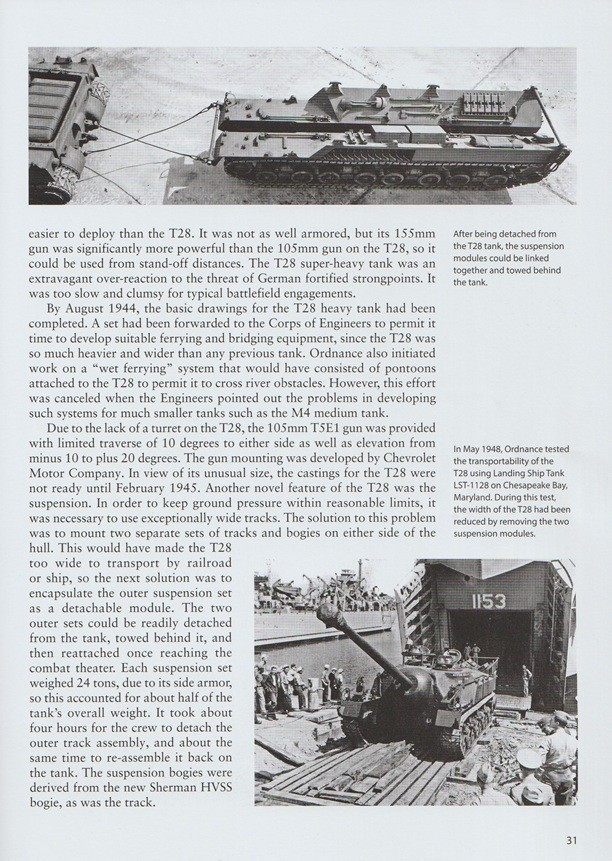
There are a total of 31 black and white photographs and 8 color photographs included in this volume. The photographs are excellent and are clear and easily viewable, including those taken during combat operations. A great number of the photographs are War Department images that were taken during testing and trial operations, and as such, are free of any background item distractions, and the reader is able to focus on just the tank itself. Some of the testing and trial images are of various tanks being tested for suitability on tactical bridging, transportability on an American LST (Landing Ship Tank), and test loading on a T79 100-ton 10-wheel trailer. As well as the official War Department images, there are also pictures taken in combat areas of the US M4A3E2 Sherman Jumbo, one of which shows extensive battle damage. As well as images of the various tanks, the reader will also be able to view things such as testing equipment and military uniforms. Author Steven J. Zaloga stuck to the title of the book and chose subject specific photographs and did not include photographs that strayed from the main subject. The majority, if not all, of the photographs will prove to be excellent reference material due to the details they contain. The World War II military historian and the tank and weapons development enthusiast will benefit from the excellent photographs as will anyone that is interested in US heavy tank development during World War II.
THE ILLUSTRATIONS:
There are 7 illustrations included in the volume by illustrator Felipe Rodríguez. The illustrations are very well done, nicely detailed and are of:
Plate A
M6A2 (T1E1) Heavy Tank
- A one-page full color illustration showing left side, front, rear and overhead views of the tank.
Plate B
T14 Assault Tank, US Army Armored Board, Fort Knox, Kentucky, 1944
- A one-page full color illustration showing left side, front, rear and overhead views of the tank.
Plate C
M4A3E2 Assault Tank
- A one-page color illustration showing the left side and front view of two separate tanks. The two tanks shown are:
- M4A3E2 Assault Tank, B Company, 68th Tank battalion, 6th Armored Division, Germany.
- M4A3E2 (76mm), A Company, 15th Tank battalion, 6th Armored Division, Germany 1945.
Plate D
T28 Attack
- A two-page full color “what if” illustration showing a T28 super-heavy tank passing by a destroyed Japanese O-I super-heavy tank during a battle in the Japanese Home Islands. This illustration is also shown on the front cover of the book.
Plate E
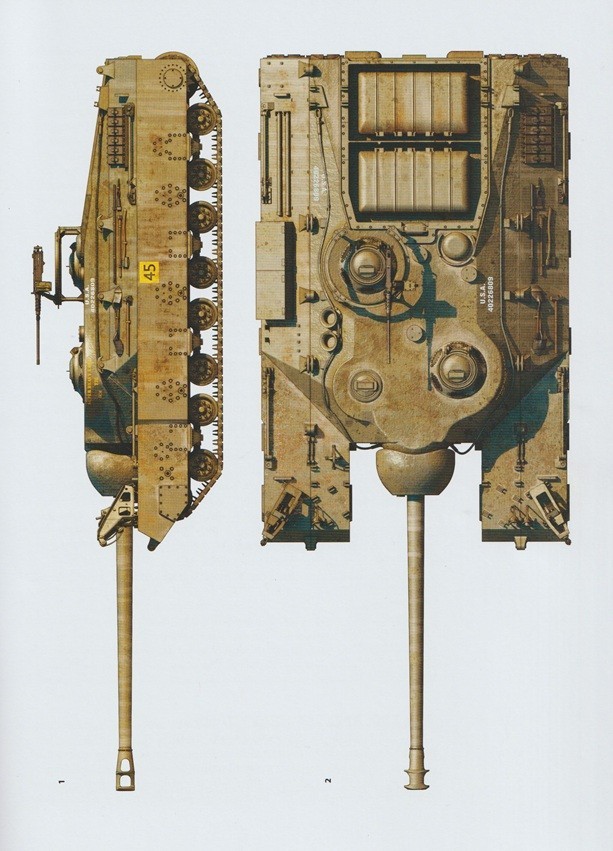
T28 Super-Heavy Tank, Aberdeen Proving Ground, 1947 (See attached scan)
- A one-page full color illustration showing left side and overhead views of the tank.
Plate F
T29E3 Heavy Tank, Aberdeen Proving Ground, 1949
- A one-page full color illustration showing overhead and left side views of the tank.
Plate G
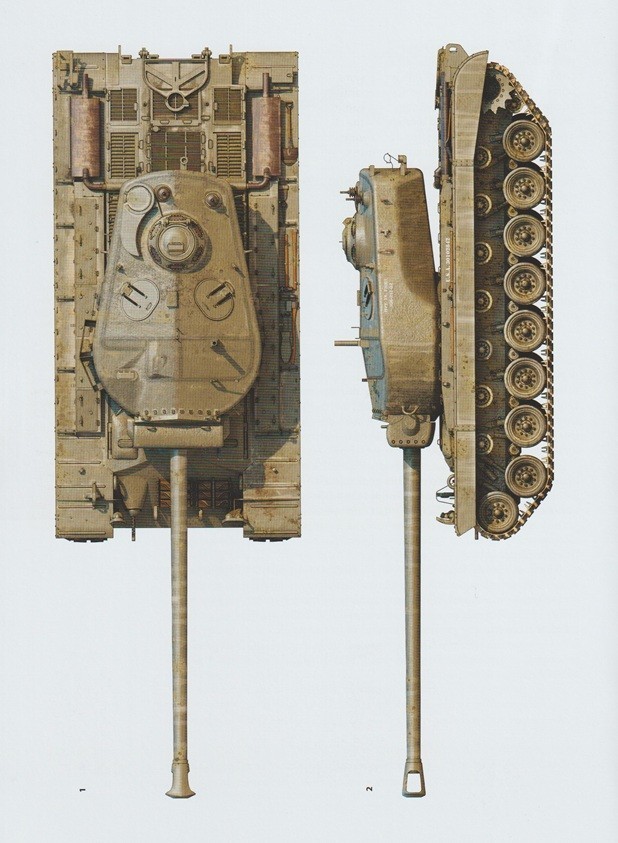
T30 Heavy Tank, Aberdeen Proving Ground, 1948 (See attached scan)
- A one-page full color illustration showing overhead and left side views of the tank.
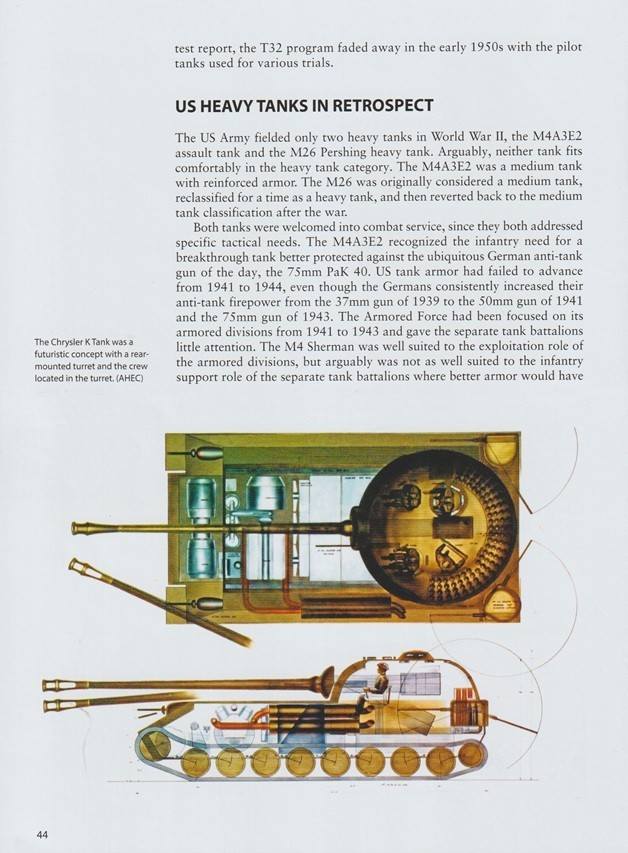
CROSS-SECTIONAL VIEWS:
There are 3 cross-sectional view scale line drawings provided in this volume. They are nicely done and detail:
- T28 Super-Heavy tank
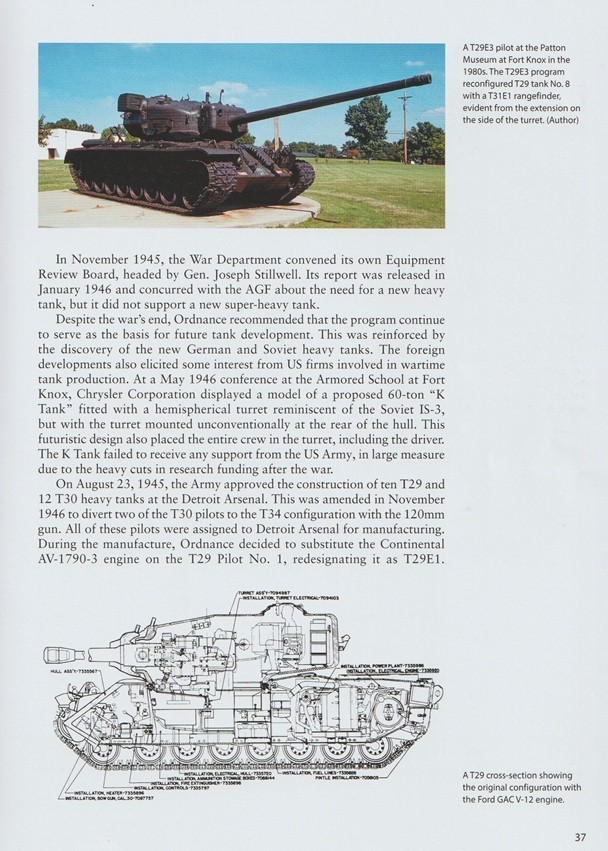
- T29 showing the original configuration with the Ford GAC V-12 engine
- T30E1 with the Continental AV-1790-3 engine
THE CAPTIONS:
The captions are well written and explain the accompanying photographs and illustrations in great detail, eliminating any doubt as to what is shown. The captions go into very specific detail as to the specific model of tank shown, manufacturing company names, tank registration numbers, weapon calibers, armor thickness, modifications and upgrades made, battle damage, dates and locations and other such pertinent information. Author Steven J. Zaloga’s captions will be helpful to the reader due to their detailed content as opposed to other captions that I have seen that are very brief and lacking in detail.
INFORMATION CHARTS:
There are 8 information charts included in this volume that provide details of:
- T1 heavy tank variants
- M6 tank production
- M6 production tanks
- Heavy tank comparison: 1943
- Heavy tank comparison: 1944
- Super-heavy tank armor comparison
- Heavy tank comparison: 1945
- Heavy tank gun performance
CONCLUSION:
As with the other Osprey Publishing titles I was impressed with this book. This is a very nice reference book that contains a well written informative text, many subject specific photographs and illustrations, well detailed captions and more, all detailing the United States development of heavy tanks during World War II. As with the other Osprey Publishing titles, I have no hesitation recommending this book to others as it will be a welcome addition to one’s personal reference library.
Osprey Publishing also offers US Heavy Tanks of World War II as:
Ebook (Epub & Mobi) ISBN: 978-1-4728-7081-0
and
Ebook (PDF) ISBN: 978-1-4728-7082-7
Osprey Publishing’s, US Heavy Tanks of World War II is also available as a Kindle version through Amazon.
PRICE:
UK £12.99 / US $20.00 / CAN $27.00
This book was provided to me by Osprey Publishing. Please mention that you saw the book reviewed here on the KitMaker Network when making your purchase. Thank you.