












HISTORY:
** The First World War is often remembered for trench warfare, massed artillery and the dominance of horse-drawn logistics—but it was also the first truly motorised conflict. Imperial German Army Motorised Troops 1914–18 Volume 1 uncovers the overlooked story of Germany’s mechanical transport and the soldiers who operated it, charting the rise of the Kraftfahrtruppen from pre-war experiments to a vital arm of the Kaiser’s army.
Drawing on extensive German-language sources and rare archival photography, Jacek Zabielski explores how the Imperial Army harnessed trucks, motorcycles, staff cars and road locomotives to meet the enormous demands of modern industrial war. Beginning with early state subsidies and the tentative establishment of motor transport battalions before 1914, the book traces how civilian vehicles were requisitioned on mobilisation, and how thousands of new machines were pressed into service to feed, equip and move the army across Europe.
The narrative examines the creation and daily operation of transport columns, depots and parks, as well as the integration of motor vehicles into specialised branches: pioneers hauling pontoons, motorcycle detachments carrying urgent messages, ambulances evacuating casualties, and aviation units relying on motorised recovery teams. Motor traction was also central to moving Germany’s heaviest siege artillery, with steam and petrol-powered tractors hauling giant howitzers across shattered landscapes.
This richly illustrated volume reproduces hundreds of rare and previously unpublished photographs, showing vehicles and their crews on every front—from the Western Front and the Balkans to the Middle East, as well as specially commissioned colour artwork. Technical detail is combined with human stories: drivers in leather tunics posing proudly by their machines, improvised adaptations to vehicles in the field, and the constant struggle against poor roads, shortages of fuel and tyres, and the sheer mechanical strain of total war.
Volume 1 lays the groundwork for understanding the broader impact of Germany’s motorized forces, which are further explored in Volume 2. **
** Quoted from the back cover of the book and the Helion and Company web site.
THE BOOK:
Helion and Company has released Imperial German Army Motorised Troops 1914-18 Volume 1
Origins, Organization, and Mechanical Innovation in the Great War as a 128-page softcover book, 8.3 x 11.7 inches in size. Included with the text are black and white photographs, color illustrations, informational diagrams and more. The book has a 2025 copyright, a publication date of October 7, 2025, and the ISBN is 978-1-8045-1764-2.
CONTENTS:
Glossary
Abbreviations used in text
Introduction
1. Origins of Military Mechanical Transport
1.1 Laying the organizational foundations
1.2 State subsidies
1.3 Initial order of battle
2. Army Transport Service
2.1 Railway transport
2.2 Organization of the Motorized Transport Troops 1914-1918
2.3 Daily service
2.4 Support services
2.5 Wartime vehicles production
2.6 Shortages of strategic materials
2.7 Motorized transport troops at the war’s end
3. Motor Vehicles Utilized by Specialized Formations
3.1 Pioneers
3.2 Motorcycle detachments
3.3 Signal service
3.4 Medical transport
3.5 Army Air Service
3.6 Naval (Marine) motorized units
3.7 Firefighting vehicles
3.8 Motorized field chapels
4. Moving the Heavy Guns
4.1 Road locomotives
4.2 From steam to benzene
4.3 Field artillery motorization
Appendix: Development Timeline of Selected German Motorized Vehicles (1914-1918)
Bibliography
THE TEXT:
Author Jacek Zabielski provides a well written and informative text detailing the motorized vehicles and the troops of the Imperial German Army that used them during World War I. The text goes into very specific detail in all areas of the book as outlined on the contents page, please refer to the contents listing that I have provided for the subjects that are covered throughout the book. The author did not do an overall history and use of vehicles lumped into basic information on the various cars, trucks, motorcycles, etc. Instead, the author has separated each of the vehicles and gives a history of each vehicle individually such as who produced it, numbers produced, which military component received the vehicle and what the vehicle’s intended role was to be and what they were used for and any failures or faults found and what was needed to correct them. Also discussed is which vehicles were taken from civilian service and placed into military service and what changes needed to be made to them. The author discusses the vehicles that were used for front line type of duties such as transporting troops and supplies, courier duties as well as prime movers for artillery pieces to other roles the vehicles were used for such as firefighting, communications, mobile post offices and mobile chapels. Author Jacek Zabielski doesn’t use what I refer to as fluff writing where a large amount of non-essential extra text is provided just to help fill the pages. As I read through the text, I did find a few misspellings and grammatical errors, however these were few and they take nothing away from the text. Grammar and spelling might not be an important factor to everyone however it is something that I take notice of and pass on my findings. I feel that author Jacek Zabielski has covered the use of motorized vehicles by the Imperial German forces during World War One very well and has provided the information in an easy-to-read format which the detailed oriented reader will benefit from.
THE PHOTOGRAPHS:
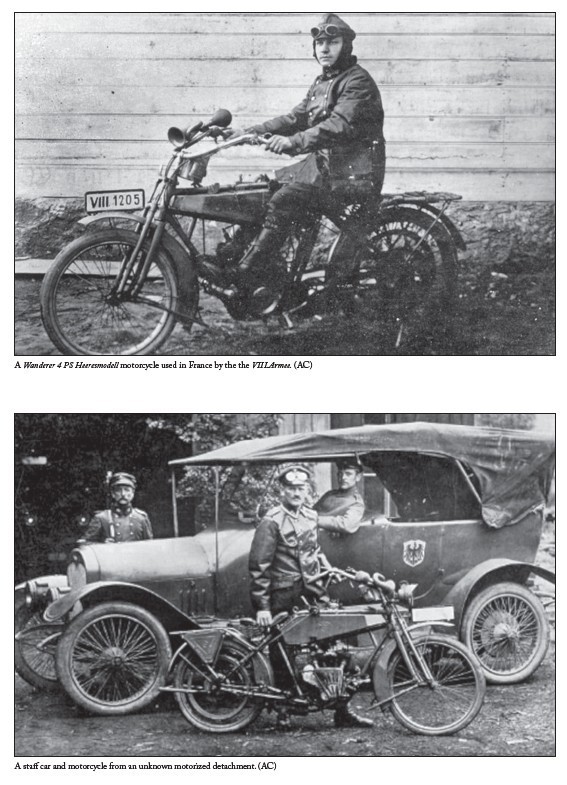
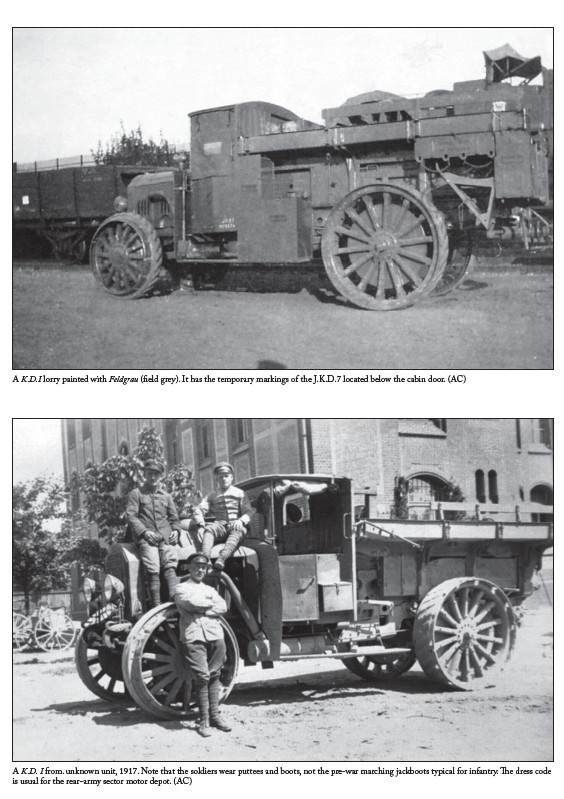
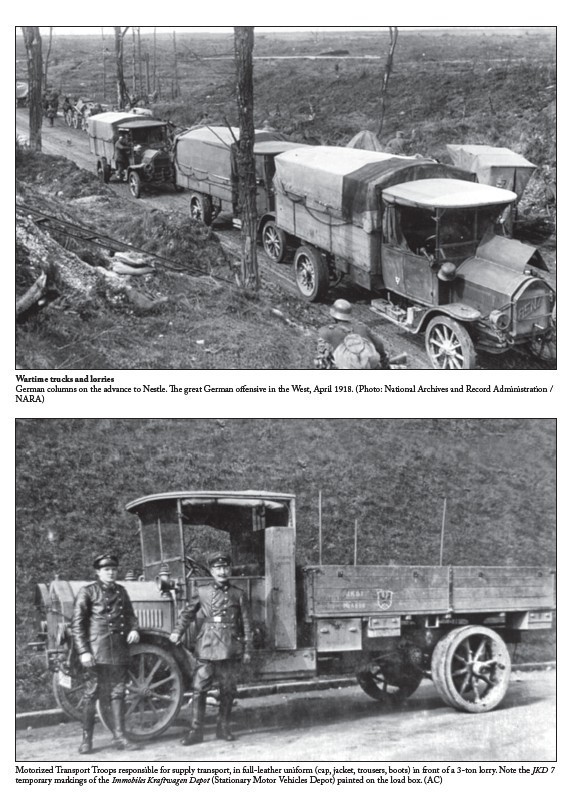
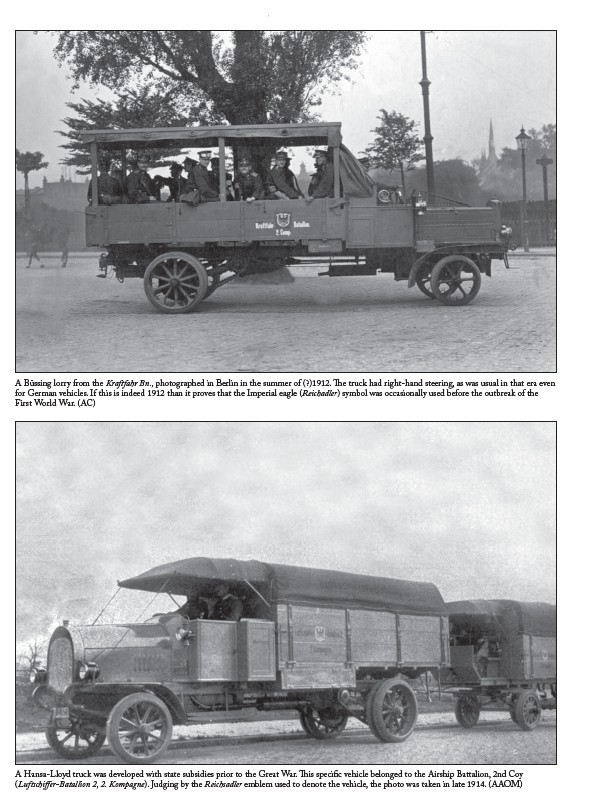
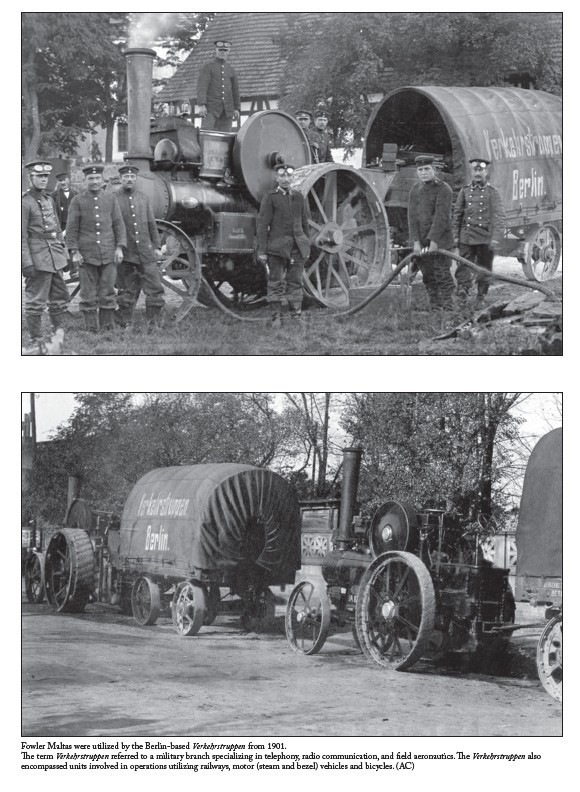
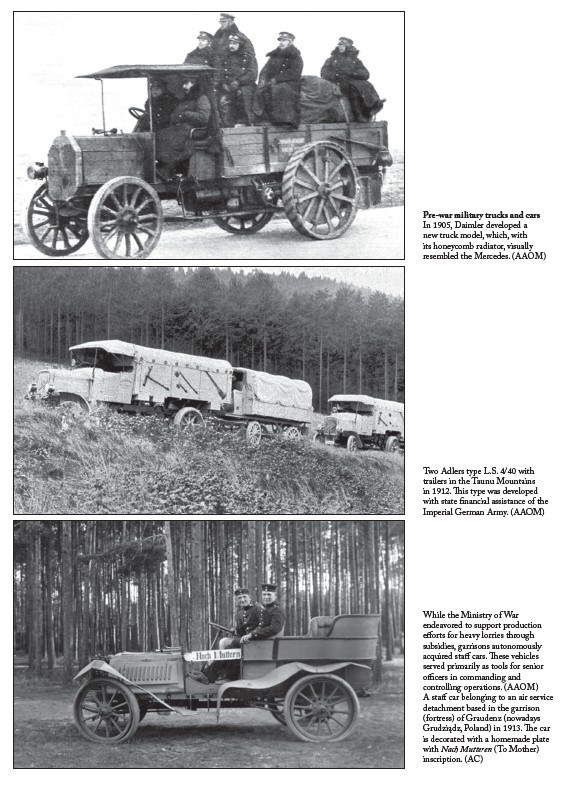
A total of 204 black and white photographs are included in this volume. There are no color photographs featured. Author Jacek Zabielski chose subject specific photographs and did not include photographs that strayed from the main subject of the book. The photographs range from wide angle photographs to close-up detailed photographs. Most of the photographs are clear and easily viewable; however, a few of them are somewhat blurry and a few of them appear to be too dark, while others appear to be too light. This can be typical for the period of history being discussed, and the quality of the photographs is of no fault of the author, and they do not take anything away from the book and the fact that they are over one hundred years old should be taken into consideration. I have seen a few of the featured photographs in other publications dealing with the same subject matter, however the vast majority of them were new to me. The book contains a wealth of period photographs of subjects such as staff cars, numerous types of trucks, various motorcycles and other such subjects of German manufacture as well as vehicles captured from other countries such as France. Also shown are tractors used as prime movers for artillery pieces, cargo trailers, aircraft such as the Sopwith Camel, Albatros D.V., Halberstadt CL.II and Spad S.XII, howitzers, railcars, galvanized transportation pontoons, German observation balloon, howitzers, small arms, uniforms, etc. The photographs also include images of damaged and wrecked vehicles as well as early camouflage patterns. The majority, if not all, of the photographs will prove to be of great interest, and excellent reference material, to the scale modeler as well as to anyone interested in Germany’s military vehicles used during World War One due to the details they contain.
There are also 5 color insert photographs of vehicle markings included. The markings shown are:
1. Kaiserlicher Automobil Club (KAC)
2. Black Reichandler symbol
3. Crowned blue-and-white Bavarian coat of arms
4. Württemberg coat of arms
5. Naval emblem of two crossed anchors topped with the Imperial crown
ILLUSTRATIONS:
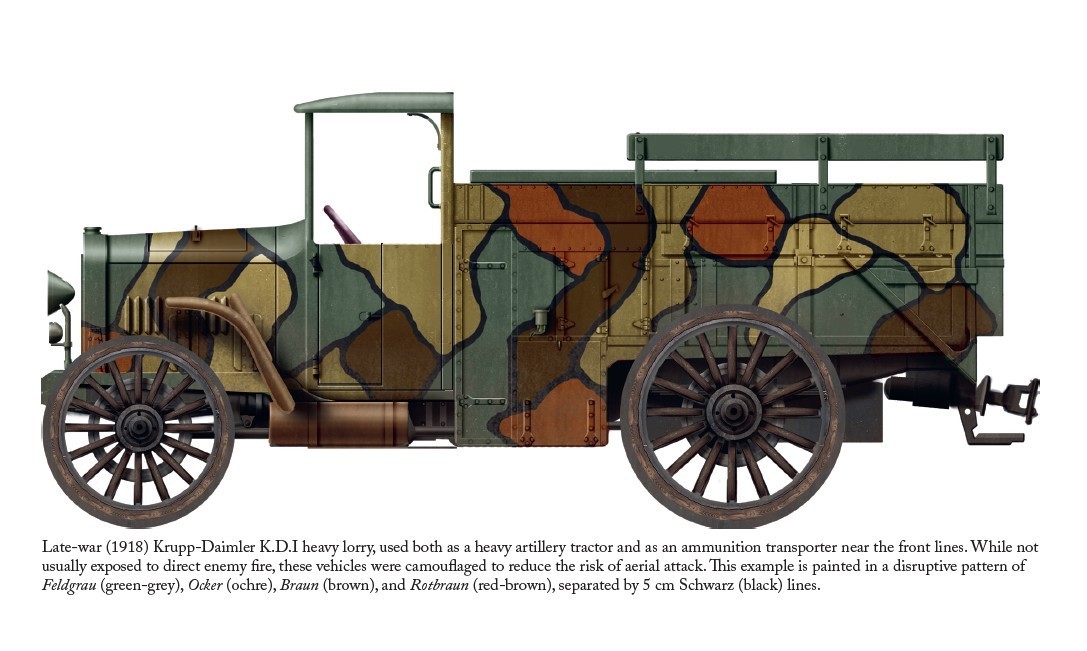
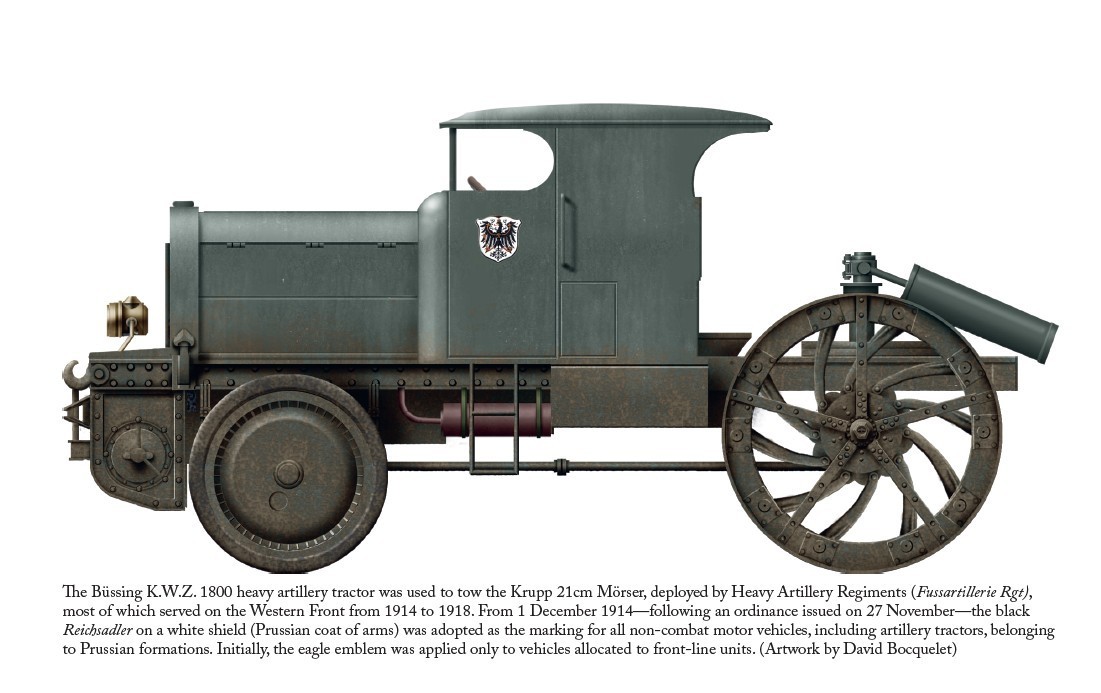
There are 9 color illustrations included in the volume by illustrator David Bocquelet. The illustrations are very well done, nicely detailed and are all left and right-side profile illustrations of:
1. Büssing K.W.Z. 1800 Heavy Artillery Tractor
2. Daimiler-Marienfelde truck
3. Late-war (1918) Krupp-Daimler K.D.I. heavy lorry
4. Krupp-Daimler K.D.I.
5. Krupp 21 cm Mörser siege mortar
6. Podeus LIII heavy lorry
7. Mercedes of the Imperial Volunteer Automobile Corps (Kaiserlichen Freiwilligen-Automobil-Corps)
8. Staff car of Admiral Ludwig von Schröder, Marinekorps Flandern, 1917
9. Opel 3-ton truck
THE CAPTIONS:
The captions are well written and explain the accompanying photographs nicely. The captions go into very specific detail as to the actions taking place, dates and locations, type of vehicle shown, who manufactured it, its model number, the color of the vehicles and numbers produced as well as their role in the military. The captions also detail various weapons shown and their caliber, individual’s names and military rank, military units and other such information. As I read through the captions, I didn’t notice any spelling or grammatical errors. I was impressed by Jacek Zabielski’s captions as they are very helpful to the reader due to their detailed content as opposed to other captions that I have seen that are very brief and lacking in detail.
INFORMATIONAL CHARTS:
There are 7 informational charts provided in this volume and they provide information on:
1. Organizational structure of the Armee-Oberkommando 1 (November 1914)
2. Order of Battle, German Cavalry Division (1914)
3. Order of Battle, German Infantry Division (1914)
4. Passenger cars production statistics
5. Order of Battle, Field Art. Rgt. (1914) & Foot (Heavy) Art. Rgt. (1914)
6. Artillery tractors delivered to the Imperial Army between 1914-1918 (estimate)
7. Development Timeline of Selected German Motorized Vehicles (1914-1918)
CONCLUSION:
I was impressed with this book. It is a very nice reference book that contains a well written informative text, many subject specific photographs, well detailed captions and more, all detailing the motorized vehicles and the troops of the Imperial German Army that used them during World War I. I would have no hesitation in recommending this book to others as it will be a welcome addition to one’s personal military reference library.
PRICE:
UK £25.00 / US $39.95
https://www.casematepublishers.com/
This book, from Helion and Company, was provided to me by Casemate Publishers. Please mention that you saw the book reviewed here on the KitMaker Network when making your purchase. Thank you.